
ASTM D7750 Webinar: True Thermoset and Prepreg Cure Data
- Home
- ASTM D7750 Webinar: True Thermoset and Prepreg Cure Data
Beyond DSC and Scientific Rheometry:
Discovering True Cure Behavior with ASTM D7750 and the Premier ESR
September 22, 2026 –
16:00 Central European Time / 10:00 AM Eastern Time (U.S.)
Duration: 45 minutes plus live Q&A | Platform: Microsoft Teams | Cost: Free
Registration will allow for either session, link included in email
DSC records heat flow. Open rheometers test unpressurized samples. Neither one reproduces the heat, pressure, and volatile constraint inside your autoclave or press. ASTM D7750 and the Premier Encapsulated Sample Rheometer do.
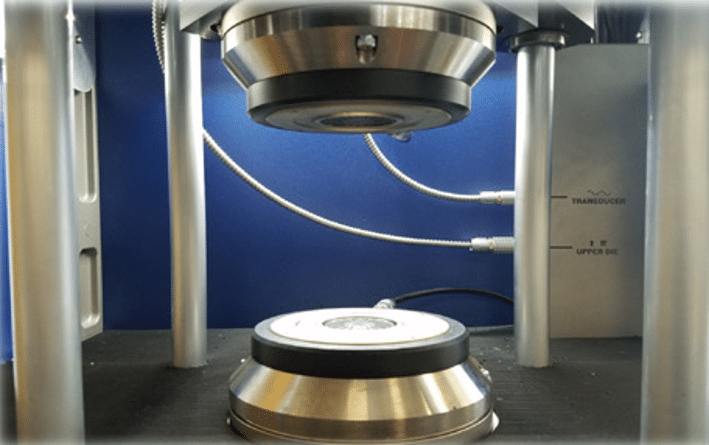
Your Cure Data Stops Where Production Starts
Laboratory results look clean. Then the part comes out of the autoclave with porosity, soft spots, or mechanical properties below specification. The material is rarely the problem. The test conditions are.
Differential Scanning Calorimetry records heat of reaction. Heat of reaction confirms a chemical reaction took place. It does not tell you when the resin stopped flowing, when it gelled, or how much modulus it built. Conventional scientific rheometers run open to atmosphere under no applied pressure, so volatiles escape and resin migrates out of the measurement zone.
Your process works differently. Autoclaves, compression molds, and sealed-cavity tools apply heat and pressure at the same time and hold volatiles in place. Cure data collected under academic conditions does not predict behavior under production conditions.
The data was never wrong. It was incomplete.
The cost of the gap is familiar to every process engineer working with thermosets:
- Porosity and voids traced back to pressure applied at the wrong point in the cycle
- Incomplete cure caught at final inspection instead of during development
- Cure cycles built through empirical trial and error, then defended with limited data
- Scrap and rework absorbing margin on qualified aerospace and rail programs
ASTM D7750 defines the standard method for measuring the full progress of dynamic mechanical properties during cure. Rather than inferring cure state from heat flow, the method tracks the mechanical properties your part depends on, in real time, across every stage from liquid through gelation and vitrification into the glassy state.
The method delivers:
- Resin behavioral properties across the complete cure
- Cure kinetics and gel point identification
- Real-time tracking of the full cure process
- Data for resin formulation optimization
- End-use temperature range identification
- Production efficiency grounded in measured mechanical response
What ASTM D7750 Standardizes
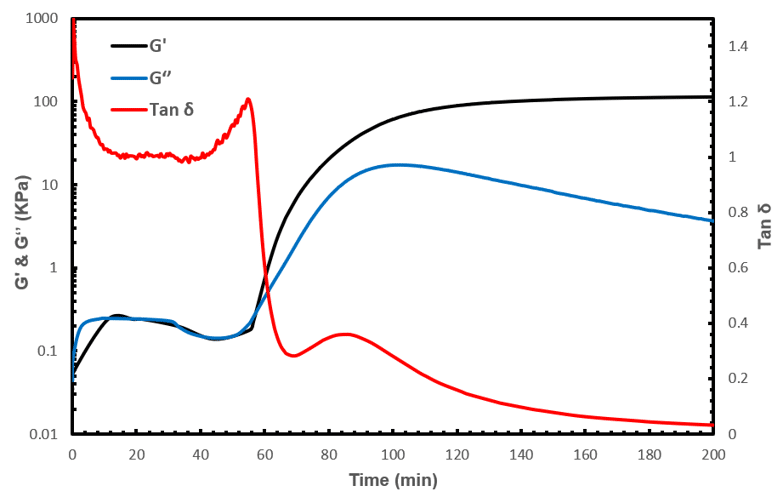
One Specimen. One Run. Five Sets of Data.
The Premier ESR delivers integrated 5-in-1 characterization from a single 38 mm specimen:
viscosity – Cure behavior – Glass transition temperature (Tg) – Solid-state moduli
Other techniques deliver one or two of these and require separate instruments, separate samples, and separate operators for the rest. Sample-to-sample variation then gets built into every comparison you make.
Cutaway diagram of the Premier ESR
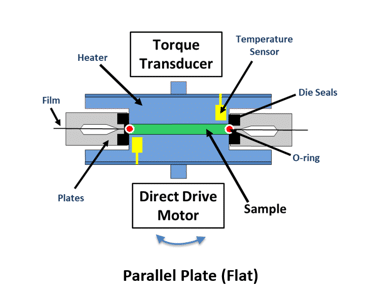
Inside the Encapsulated Specimen Rheometer
- Encapsulated test cavity: holds the specimen in place, prevents oxidation, and stops resin from escaping the measurement zone
- Parallel grooved dies: designed for resins with fiber or filler reinforcement, reducing sample slippage
- Direct die heating system: controls cure temperature accurately from ambient to 350 °C
- Oscillatory drive system: applies sinusoidal oscillation at controlled conditions
- Torque transducer: measures viscoelastic response, storage and loss moduli
- Temperature and pressure sensors: record conditions in real time throughout the cure reaction
Where the Premier ESR Meets the Standard
| Requirement | ASTM D7750 Specification | Premier ESR Performance |
|---|---|---|
|
Encapsulated cavity |
Must prevent oxidation and resin loss |
Fully sealed cavity |
|
Torque sensitivity |
0.01 dNm |
0.01 dNm precision |
|
Temperature control |
±3 °C uniformity |
Direct cavity heating |
|
Frequency range |
0.002 to 50 Hz |
0.002 to 50 Hz |
|
Calibration traceability |
Required |
ISO 17025 certified |
|
Data outputs |
G’, G”, tan δ vs. time and temperature |
Auto-processed in Enterprise software |
What the Webinar Will Cover
- Where DSC and open-cavity rheometry stop short of production conditions
- What ASTM D7750 standardizes, and why the sealed cavity changes the result
- Specimen preparation in three steps: cut 38 mm disks, stack to thickness, seal with an O-ring
- Four methods for determining the gel point, and the conditions suiting each one
- Two methods for determining glass transition: intersection of tangent lines on the log G’ curve (Tg) and the tan δ peak (Tt)
- Reading a complete ASTM D7750 output, from minimum G’ through post-cure Tt
- Live Q&A with Alpha applications and business development specialists
Who Should Attend:
- Lab managers running thermoset and composite characterization
- R&D engineers and managers developing resin systems and prepregs
- Materials scientists working on epoxy, phenolic, and bio-based thermoset chemistries
- Production and process engineers optimizing autoclave and press cure cycles
- Quality managers accountable for cure verification and yield
Applications include thermosetting resins, composite prepregs, adhesives, epoxy and phenolic systems, electronic encapsulation materials, and emerging bio-based thermosets across aerospace, automotive, and rail.
About The Presenter:
Berrin Degirmenci
Business Development Manager,
EMIA, Alpha Technologies

Berrin brings more than 15 years of polymer industry experience to her role as EMIA Business Development Manager at Alpha Technologies. Her background as an applications engineer gives her a practical understanding of how testing instruments perform in real-world lab and production environments. She works with manufacturers across Europe, the Middle East, India, and Africa to match the right testing solutions to their materials characterization needs.
Why Engineers Trust Alpha Data
More than 18,000 rheological testing installations across over 90 countries
ISO 17025 accreditation for traceable calibration
7 degreed application engineers and 50+ field service technicians supporting customers globally
25 customer and technical support representatives across 150+ direct associates
Bring Production Conditions Into Your Cure Data
Tuesday, September 22, 2026. 60 minutes. No cost.
Registration takes under a minute. The Teams link arrives by email closer to the date.