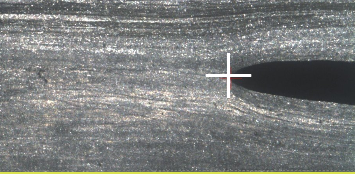
Resistance to crack propagation is a key determinant of the durability of elastomeric parts. This paper examines whether the micro-dispersion state of carbon black fillers, assessed through the strain sweep measured with an RPA (Rubber Process Analyzer), can predict the fatigue crack growth rate measured by dynamic mechanical analysis (DMA) equipped with automated optical crack tracking.
Download “Impact of Filler Distribution on Crack Propagation in Rubber Compounds” to see the equipment used, the methodology, and the results for yourself.
SBR compounds characterized
carbon blacks: N220 and N550
filler loading levels each
The RPA was used to measure the Payne effect of each compound, and the DMA+ with automated optical crack tracking was used to measure its fatigue crack growth rate.
The results show that crack growth is mainly governed by filler size, while the Payne effect is mainly governed by filler loading. A strong correlation emerges between crack growth rate and the loss factor (tan δ).
Mathieu Badard holds a PhD in the physical chemistry of materials, with more than six years of experience working on projects to develop new approaches to optimizing polymer-based materials. His work at Alpha spans various stages of composite development, including polymer chemistry, formulation, processing and characterization. These experiences have equipped him to manage research projects in collaboration with industrial partners.
Unal Yilmazoglu leads the global Applications Engineering team at Alpha Technologies, with responsibility spanning North America, Europe, the Middle East, Africa and Asia Pacific. His work focuses on advanced test method development, rheology, rubber technology and polymer material characterization, with direct applications in helping manufacturers troubleshoot quality issues, accelerate product development and expand their testing capabilities.

Ph.D., Applications Scientist
Global Applications Engineering Manager
See the equipment used, the methodology and the results for yourself, and register for our upcoming webinar.