



EBook: Driving Out Variation

Driving Out Variation in Rubber Materials

Catch raw elastomer inconsistency on the loading dock, not after it drops from the mixer.

Mooney Viscosity gives you one number, at one shear rate, at one temperature. Your plant runs across a range of all three. This eBook walks through six RPA test methods, the data behind each one, and the accept/reject specs to hand your suppliers.

The Problem

Why Mooney Viscosity Alone Lets Variation Into Your Plant

Two lots of the same raw elastomer hit the same Mooney number. One extrudes clean. The other comes out wavy, tears at the die, and ties up the mixer for an extra pass. Nothing on the certificate of analysis warned you.

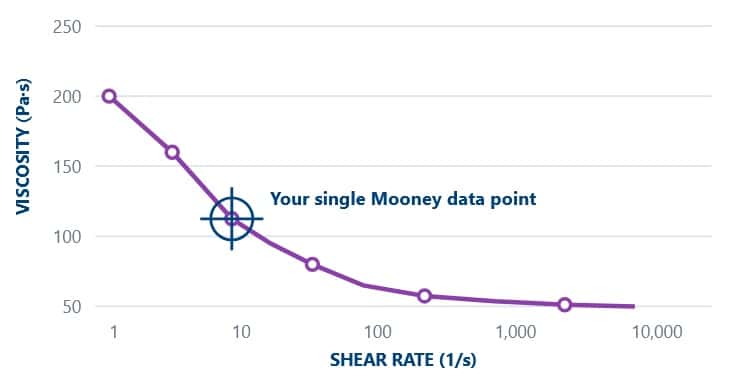
Mooney measures viscosity at 10 reciprocal seconds, at room temperature, with state of cure at zero. One point on a curve. Your process lives everywhere else on that curve.

A 70 Mooney elastomer at 10 reciprocal seconds behaves like a 20 Mooney elastomer at 20 reciprocal seconds. Temperature moves it again. Viscosity of 35 Pa·s at 100°C falls to 5 Pa·s at 125°C, and 125°C is where you actually process.

By the time you test the batch coming off the mixer, the variation is already in your product. Every rejected lot, every extra mixing pass, and every scrap ticket traces back to a raw material nobody characterized.

Where your process actually runs

PROCESS STEP SHEAR RATE (1/S)
Mooney viscometer test 10
Compression molding 20
Mixing 50
Extrusion 500
Injection molding 1,000

Premier RPA tests physically to 48 reciprocal seconds, then applies the Cox-Merz correlation out to roughly 550 reciprocal seconds. One sample. One instrument.

What it costs you

Rework on the mill. Extended extrusion set-up time. Scrap you pay for twice, once in material and once in the slot it took on the line. Suppliers with no spec to test against, so nothing changes next shipment.

Viscosity is shear rate dependent

Figure 1 from the eBook. Everything to the right of the crosshair is your process, and none of it appears on a Mooney certificate.

What's Inside

Six RPA Test Methods to Get Elastomeric Materials Under Control

Each method in the eBook comes with the problem it solves, the figures from real samples, and the spec language to give your suppliers.

Frequency Sweep (ASTM D6204)

Run one sample across the full frequency range and read molecular weight distribution off the slope. A steeper slope means broader MWD. A shallower slope means narrower.

Catches

Two elastomers with matching Mooney values and completely different mold flow and surface finish.

High Strain Sweep

Push the material past the Linear Viscoelastic Region, where mixing and extrusion actually happen. Sharp S’ peaks point to entanglements or long chain branching.

Catches

Grades that fight you in the mixer, ranked before the material ever goes on the mill.

Crossover Frequency Test

Find the point where G’ crosses G”. That single frequency tells you whether molecular weight runs high or low and whether distribution is narrow or broad.

Catches

Supplier-to-supplier drift, as one go/no-go number your shop floor reads without exporting to Excel.

FT-Rheology via LAOS

Apply Fourier Transformation to the distorted torque signal and quantify long chain branching with two LCB indexes. Insensitive to molecular weight and MWD.

Catches

Branching and filler dispersion differences in minutes, where other methods take hours.

Payne Effect and Strain Jump

Measure how big the filler network is, then drop the strain suddenly and measure how fast it rebuilds. Two numbers quantify the filler networking process.

Catches

The real effect of a new filler, coupling agent, or functionalized polymer against a control compound.

Thermal Stability Time Sweep

Run a rheological time sweep at high temperature in the sealed cavity. Chain scission shows as falling viscosity. Branching shows as a rise.

Catches

Antioxidant performance at 185 to 220°C, where TGA shows no weight loss until 300°C.

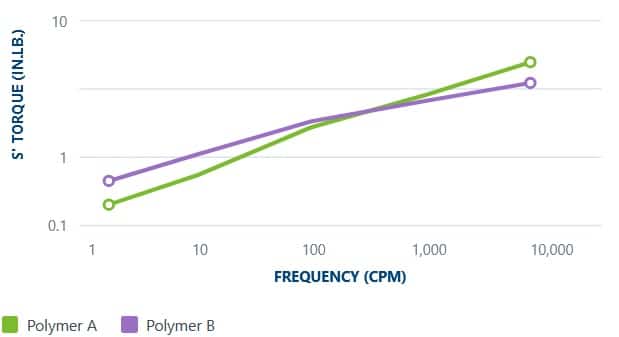
Two nitrile grades. Same Mooney. Different molding behavior.

Figure 3 from the eBook. Both polymers look identical on a Mooney viscometer. Polymer B is far harder to injection mold.

Data your suppliers will act on

A supplier runs the test, sends the data, and nothing changes. Why? Because the manufacturer never defined an accept/reject spec to compare it against. The data sits there as information with no corresponding action.

The eBook closes that loop. Every method includes what to measure, what range to hold, and how to write it into a specification your raw elastomer supplier tests against before shipping.

Suppliers run ASTM frequency sweeps as an exploratory method to find the cause of an issue. That is actionable information, and it means no scrap the next time around.

Case Study

Two suppliers of the same raw rubber. One always produced wavy extrusions, like waves in the sea.

Crossover frequency testing followed by LAOS showed the supplier’s raw rubber fell short of what the manufacturer’s process required. When the results went to the supplier, they agreed.

Before that testing, the supplier had no picture of molecular weight distribution at all. They knew Mooney Viscosity, because Mooney Viscosity was the only thing the manufacturer ever asked for.

Three more case studies sit inside the eBook, covering nitrile grade selection, a silicone QC test, and an EPDM gel problem screened in under 10 minutes on five grams straight from the bin.

What's Inside

What You Get in the 33 Pages

right

22 figures from real samples, with axes and test conditions included

right

Correlation of ASTM D6204 with Mooney across 23 polymers, R value of 0.97

right

Silicone QC test built on the crossover point to give one go/no-go value

right

Filler and additive testing covering Payne effect and strain down-jump

right

Spec language for accept, reject, and exception criteria

right

Tan delta guidelines for reading liquid, uncured, cured, and solid behavior

right

Nitrile case study comparing nine grades by molecular weight and peak shape

right

EPDM gel content study screening pass and fail compounds on five grams

right

6PPD and antioxidant screening with a rapid rheological time sweep

right

Peer-reviewed references for ASTM D6204, LAOS, and Payne effect work
The Instrument

About the Premier RPA

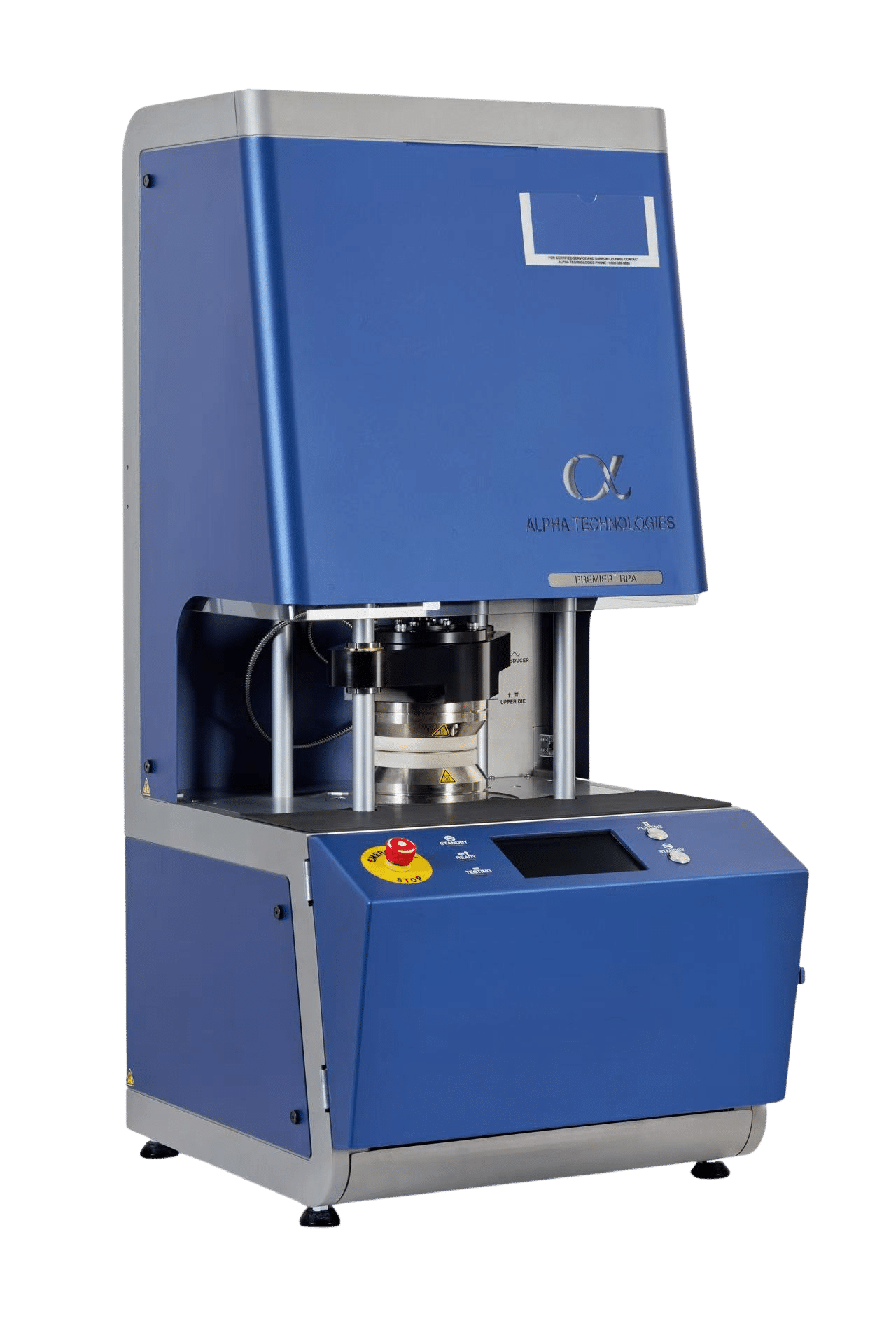
The Premier Rubber Process Analyzer applies oscillatory shear across shear rate, temperature, and state of cure. One sample. One instrument. One test.

Alpha Application Specialists work with elastomer suppliers and rubber product manufacturers worldwide to build these methods into routine QC.

Get the Driving Out Variation eBook

Six test methods, 22 figures, four plant-floor case studies, and the spec language to take to your suppliers. Written by the Alpha applications engineers who run these tests every week.

Alpha Technologies has applied rheology science to rubber and polymer testing for more than 60 years.

Common Questions

Raw Material Testing Questions, Answered

A Rubber Process Analyzer applies oscillatory shear to a sample and measures elastic modulus, viscous modulus, and tan delta across a range of frequencies, strains, and temperatures. A Mooney viscometer returns one viscosity value at a single shear rate and temperature. The RPA gives you the whole curve. Mooney gives you one point on it.

ASTM D6204 is the standard test method for rubber measurement of unvulcanized rheological properties using rotorless shear rheometers. Run as a frequency sweep, it separates materials with identical Mooney values by molecular weight distribution. The slope of the curve tells you how varied the chain lengths are.

An RPA generates a Mooney reading for specifications still written to that requirement, so one instrument covers both. It also adds frequency sweeps, strain sweeps, crossover frequency, and LAOS, and it loads samples automatically instead of by hand.

The crossover point, also called the gel point, is the frequency where the elastic modulus G’ equals the viscous modulus G”. Where that point lands indicates higher or lower molecular weight and narrower or broader molecular weight distribution. It gives product manufacturers a single value for an accept or reject specification.

Lab and QA-QC managers setting incoming material specs, plant and production managers tracing process problems back to raw materials, process and materials engineers selecting elastomer grades, and purchasing teams who need testable criteria to hold suppliers to.

About Alpha Technologies

Alpha Technologies is the leader in applying rheology science to testing that makes a difference in the rubber and polymer world. With over 60 years of experience, we develop advanced testing instruments and software, enabling our customers to continuously improve the value of their materials. Our mission is to provide the insight our customers need to ensure the quality, sustainability, and performance of their materials.

Related Resources