

Introduction
Creep is one of the most fundamental and dominant analytical tools used to study material behavior. These measurements help characterize the response of materials to a static load and their behavior once the same static load is removed.
Creep tests can be utilized in two ways: (1) to obtain fundamental information about a polymer, or (2) to investigate the material response under real, application-relevant conditions. These measurements can provide useful information about a material, such as relaxation time or permanent deformation. From an application point of view, the ability to create stable materials can be evaluated using creep measurements.
Moreover, creep measurements performed at different temperatures can be used to estimate the aging behavior of a material. This aging estimation can be carried out using the in-built Dyna+ software function known as TTS (Time–Temperature Superposition). This function allows the construction of time–temperature master curves by selecting a reference temperature. The master curve building process is explained in the application note titled “Building Frequency Temperature Superposition Master Curves.”
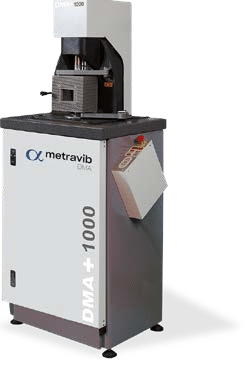
This creep study was performed on PP (polypropylene) using the Alpha Metravib DMA+1000.
FREE DOWNLOAD
Introduction to Dynamic Mechanical Analysis for Rubber Materials
Materials & Methods
PP is characterized by its high toughness, rigidity, and crystalline nature, and is commonly used in industrial applications such as piping systems. The dimensions (h × b × t, mm) of the specimen used for this study were 6.5 × 19.3 × 2.9 mm, respectively. The specimens were tested in tension mode (Figure 2).
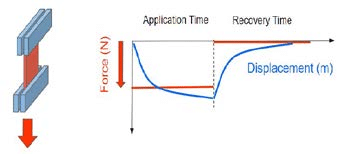
A static stress of 5 × 10⁶ N/m² was applied for 1800 seconds, with a maximum displacement of 0.005 m. This static loading step was followed by a recovery period of 1800 seconds.
Since the objective was to study creep behavior together with TTS, creep measurements were performed at several temperatures ranging from 15°C to 95°C, with a stabilization time of 15 minutes at each temperature. The test parameters are summarized in Table 1.
| Static Stress (N/m²) | 5 × 10⁶ |
|---|---|
| Duration (s) | 1800 |
| Temperature (°C) | 15 to 95, in 5°C steps |
| Stabilization time at each temperature (min) | 15 |
| DMA | DMA+1000 |
| Test mode | Tension |
FREE DOWNLOAD
Introduction to Dynamic Mechanical Analysis for Rubber Materials
Results
Figure 3 shows the static displacement obtained as a result of the applied static force at different temperatures from 15°C to 95°C. It can be observed that applying the static force for 1800 seconds was sufficient to reach displacement stabilization, except at the highest temperatures used in the measurements. Similarly, the recovery time of 1800 seconds was also sufficient.
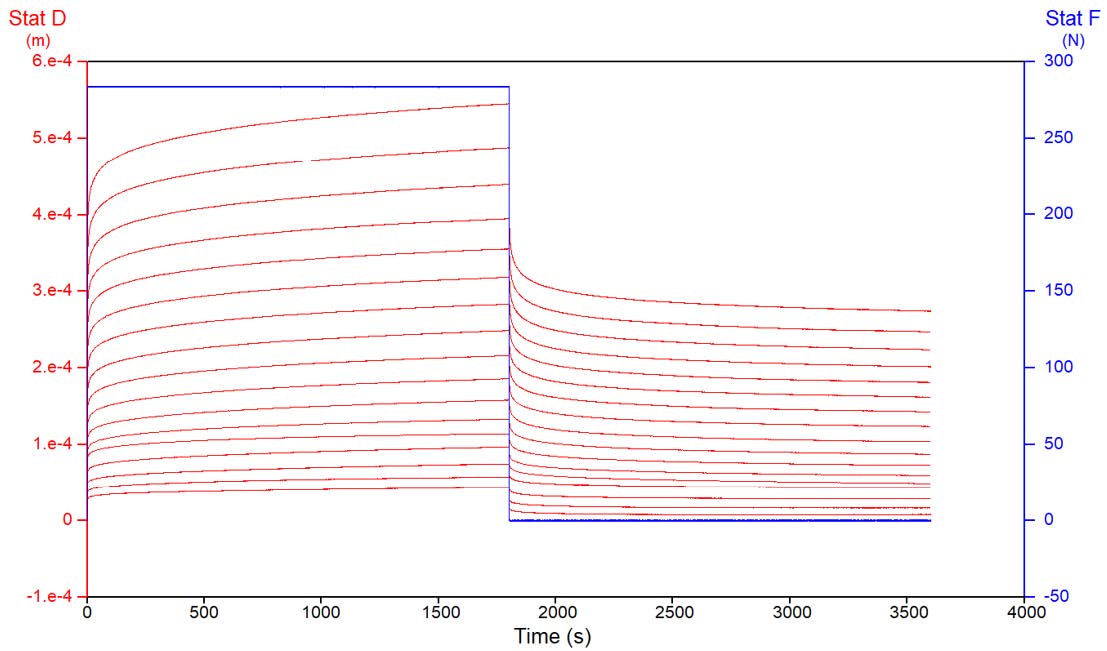
Temperature is one of the most important variables, as most materials exhibit significantly different behavior below and above their glass transition temperature. Lowering the temperature reduces the mobility of polymer chains, leading to a decrease in free volume and, consequently, a reduction in creep [1,2]. This temperature effect can be clearly observed in Figure 3.
Creep data collected at several temperatures were used to construct a master curve at a reference temperature of 20°C. This master curve makes it possible to predict the creep behavior of the material at the reference temperature over a very long time scale. Master curve calculations were performed using both WLF and Arrhenius theories, and the corresponding coefficients are shown in Figure 4.
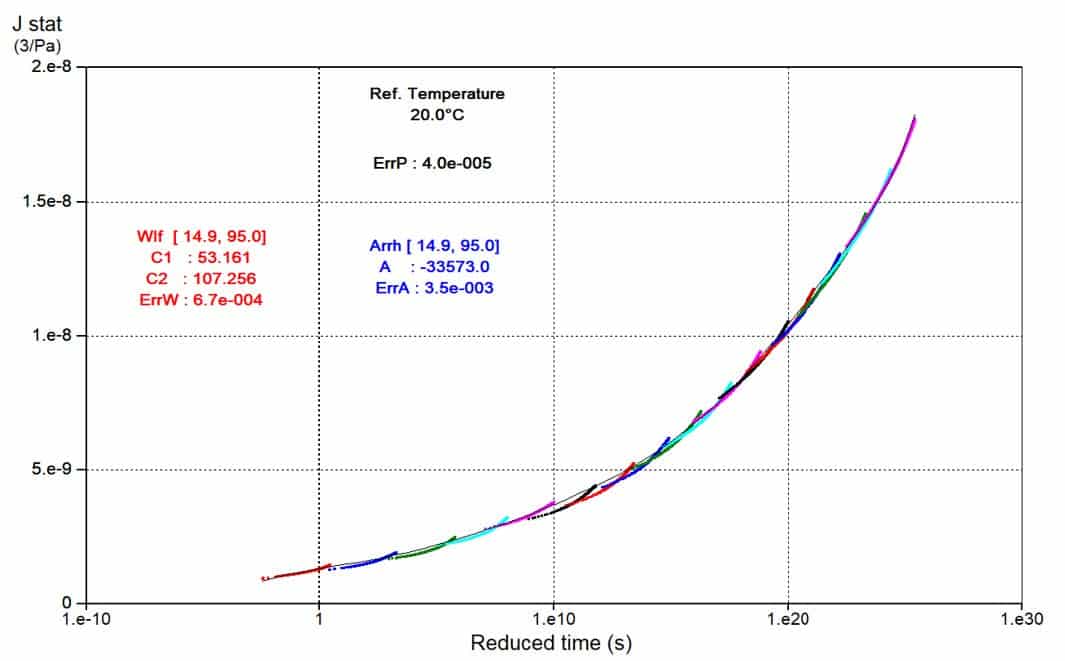
This TTS application enables analysis of creep behavior over several decades of time. This TTS module is particularly useful when limited experimental time is available but long-term material behavior is required.
Conclusions
This study demonstrates the capability of the DMA+1000 to perform creep measurements in combination with its in-built, user-friendly software functions for calculating and plotting master curves. The study successfully enabled the calculation and construction of a master curve at a reference temperature of 20°C, as well as the determination of WLF and Arrhenius coefficients. To download the full PDF, click here.
KEY TAKEAWAY
By combining creep testing with TTS, long-term material behavior can be predicted from short-term experiments, providing an efficient approach to evaluating aging and stability with the Alpha Metravib DMA+1000.
References
- Kevin P. Menard. Dynamic Mechanical Analysis: A Practical Introduction.
- C. Macosko. Rheology: Principles, Measurements and Applications. VCH, New York, pp. 119–121.
LEARN MORE ABOUT DMA
Introduction to Dynamic Mechanical Analysis for Rubber Materials
How rubber engineers evaluate real world material behavior
Inside the guide: guidance for improving analysis quality and useful direction for integrating DMA into research, development, and testing workflows.