
Mooney viscosity is still the go-to processability number for raw polymers and rubber compounds, but it is a single-point, low-shear measurement. This application note shows how a customized Alpha MV-RPA test on the Premier RPA reproduces Mooney viscosity with excellent correlation, while capturing the nonlinear behavior that matters in real processing.
- Raw elastomers: ML (1+4) = 7 × S′ with R² = 0.996 across 17 unfilled elastomers
- Filled compounds: ML (1+4) = 8.70 × S′ with R² = 0.998 across 7 compounds with reinforcing fillers
- One Premier RPA test delivers Mooney-equivalent results plus elastic and viscous data
Why Look Beyond Mooney Viscosity
Mooney viscosity remains a widely used indicator of elastomer processability for raw polymers and rubber compounds due to its simplicity, long-standing adoption, and strong relationship to molecular weight. However, as a single-point, low-shear measurement, it does not fully represent the nonlinear viscoelastic behavior encountered during modern processing operations such as extrusion, calendering, and injection molding.
The Rubber Process Analyzer (RPA) provides a production-ready alternative by enabling controlled strain, frequency, and temperature testing under processing-relevant conditions. This application note demonstrates how a customized Alpha MV-RPA test on the Premier RPA delivers Mooney-equivalent measurements with excellent correlation to standard Mooney viscosity, while offering deeper insight into material structure and processability.
Oscillatory rheometer
- Flow curves: viscosity/shear stress vs. shear rate
- Molecular architecture: MW, PDI (MWD), LCB
- Stress relaxation modulus and damping function
- Stability (gel formation)
Dynamic mechanical analyzer
- Viscoelastic properties correlating with modulus, hardness, resilience
- Energy dissipation (heat build-up)
- Damping, rolling resistance (tan δ)
Processability tester
- Process viscosity (pseudoplasticity index)
- Die swell and mill shrinkage (tan δ)
- Filler structure, particle size and dispersion
- Mooney correlation
Advanced cure meter
- Isothermal and non-isothermal cure
- Cure kinetics and simulation (mold profile)
- Process safety (scorch)
Figure 1. Capabilities of the Premier RPA for advanced elastomer characterization
The Premier RPA bridges traditional Mooney testing with advanced rheological characterization. Unlike the Mooney viscometer, which operates at a fixed shear rate and deformation mode,1 the RPA applies controlled oscillatory shear over a wide range of strain amplitudes and frequencies, which enables evaluation of both viscous flow resistance and elastic network response.2
The Alpha MV-RPA Test
Mooney equivalency requires probing the nonlinear deformation regime, where molecular entanglements and transient elastic resistance govern material behavior. The customized Alpha MV-RPA test is designed around this principle, using high strain amplitudes and low oscillatory frequencies to replicate Mooney-like deformation while preserving the repeatability and automation of the Premier RPA.
The dynamic elastic torque S′ measured by the RPA was compared against Mooney viscosity ML (1+4) for two sample sets: 17 unfilled raw elastomers and 7 filled rubber compounds.
Table 1. Test overview
| Parameter | Setting |
|---|---|
| Instrument | Premier RPA |
| Test | Alpha MV-RPA (customized) |
| Temperature | 100 °C |
| Frequency | Low |
| Strain amplitude | High (nonlinear regime) |
| RPA result | Dynamic elastic torque S′ (dNm) |
| Reference | Mooney viscosity ML (1+4) (MU) |
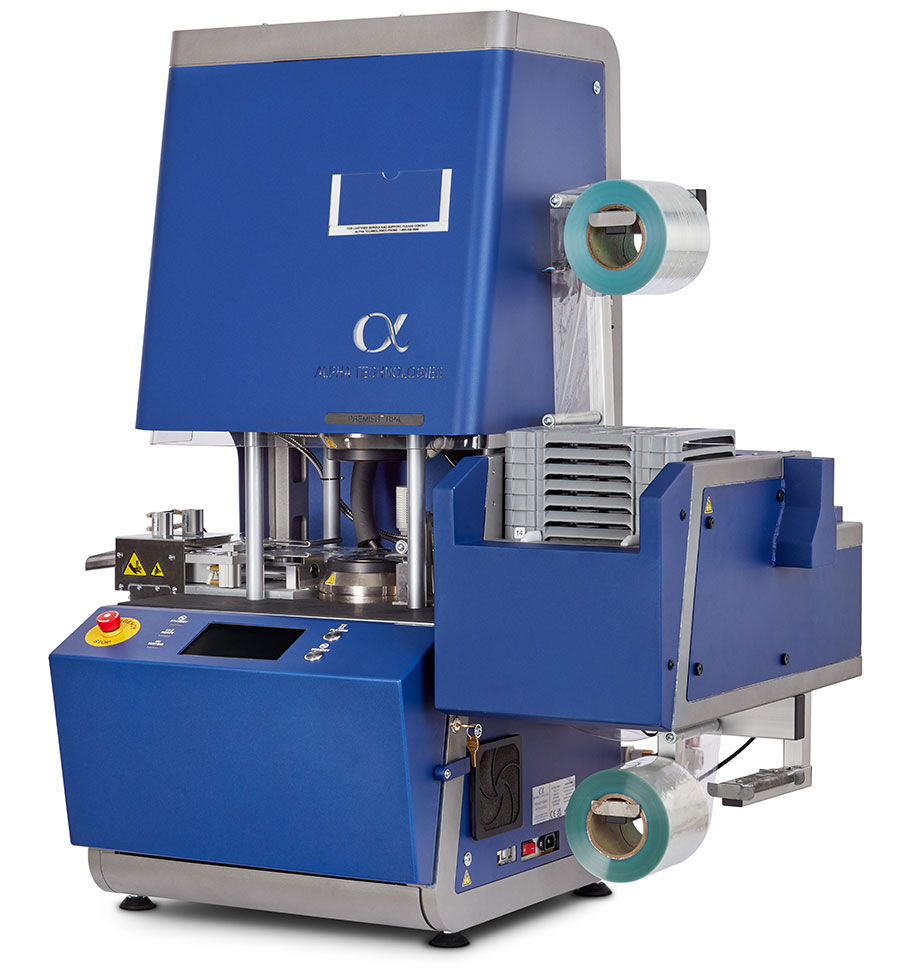
Premier RPA from Alpha Technologies
Mooney Correlation for Raw and Filled Rubber
Raw elastomers. Figure 2 shows the relationship between S′, measured at 100 °C, low frequency, and high strain amplitude, and Mooney viscosity across a wide range of elastomer types, including EPDM, BR, IIR, NBR, and SBR. Despite significant differences in molecular architecture such as monomer composition, branching, and chain topology, the correlation remains robust: ML (1+4) = 7 × S′, with R² = 0.996.
This behavior reflects the shared molecular origin of both measurements. Higher Mooney viscosity and higher S′ values are both associated with increased molecular entanglement density and longer relaxation times.3 Importantly, the RPA measurement captures this response under deformation levels that are more representative of real processing conditions.
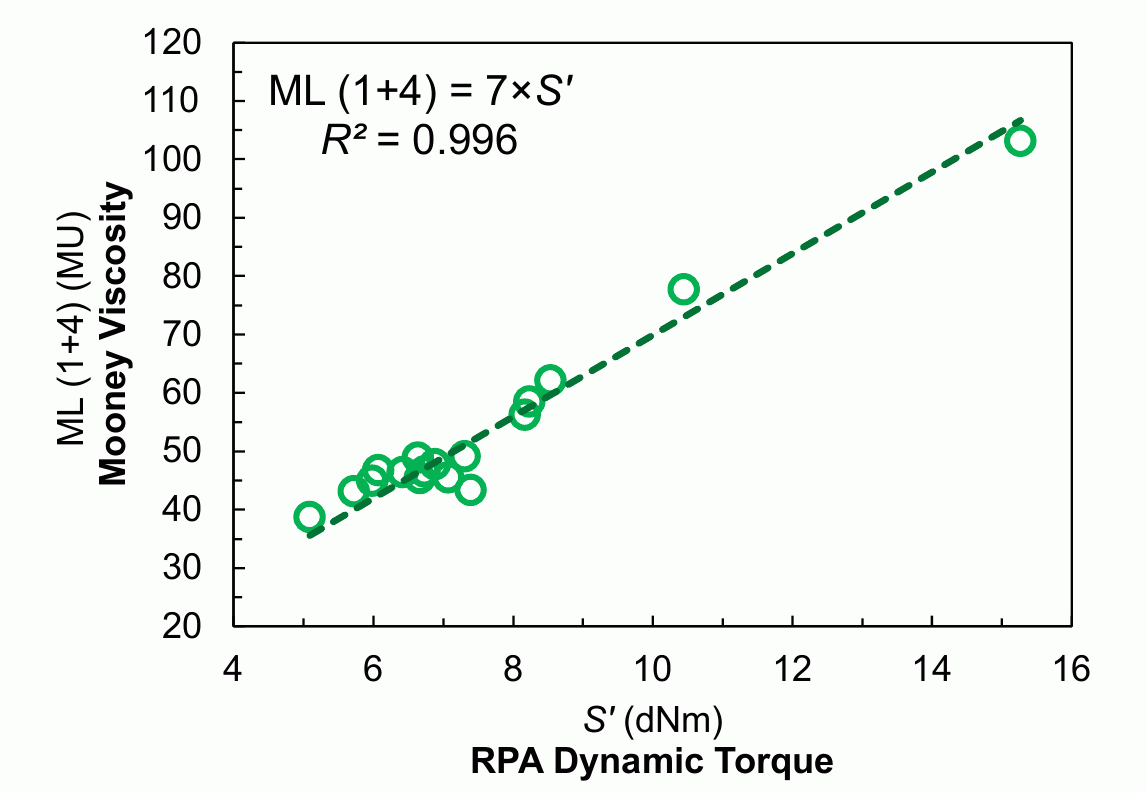
Figure 2. Correlation between Mooney viscosity ML (1+4) and the dynamic elastic torque S′ measured by the Premier RPA under high-strain conditions for 17 unfilled elastomers
Filled compounds. In filled rubber compounds, correlation becomes more challenging due to filler-filler networking and strong strain-dependent nonlinearity. The critical strain for network breakdown is often several orders of magnitude lower than that of unfilled elastomers, which requires careful selection of test conditions.
Using the Alpha MV-RPA test protocol, excellent agreement between RPA elastic torque S′ and Mooney viscosity is also observed for filled compounds when sufficiently high strain amplitudes are applied.
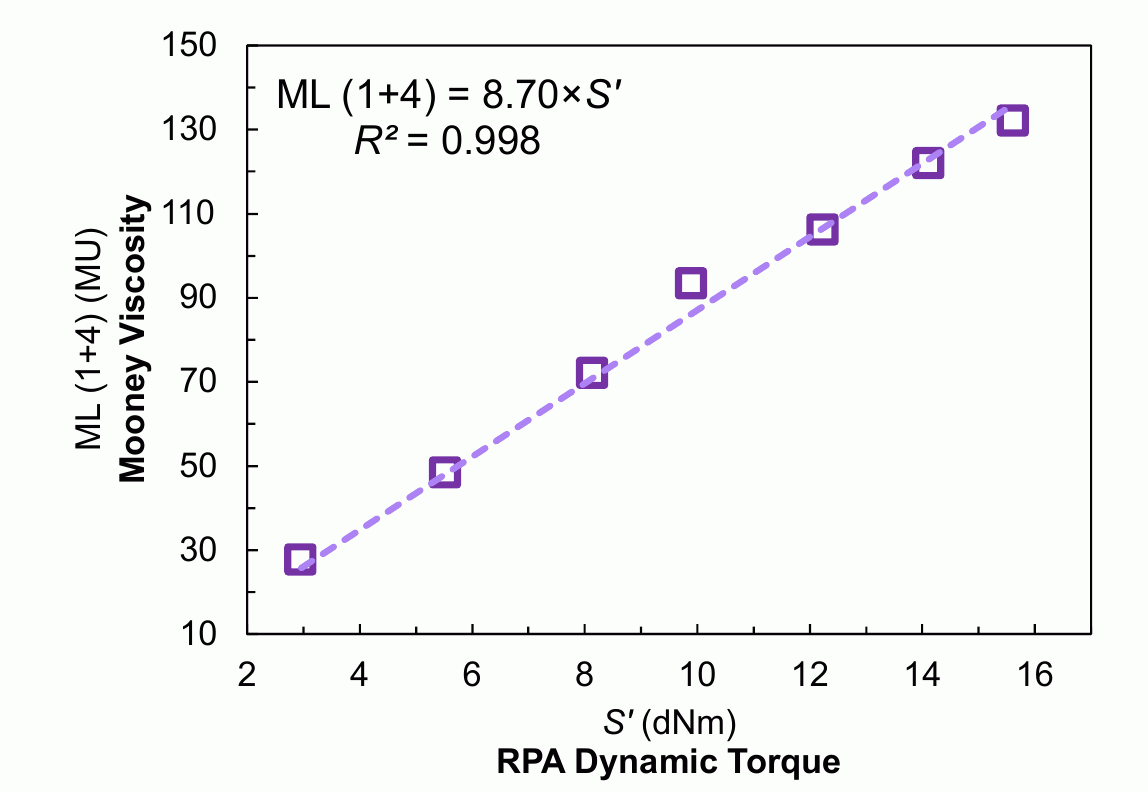
Figure 3. Correlation of the Premier RPA dynamic elastic torque S′ with Mooney viscosity ML (1+4) for 7 rubber compounds at 100 °C, low frequency, and high strain
As shown in Figure 3, S′ measured at high strain amplitude maintains a strong linear correlation with Mooney viscosity for multiple rubber compounds containing reinforcing fillers: ML (1+4) = 8.70 × S′, with R² = 0.998. This confirms that, when properly configured, the Premier RPA can reproduce Mooney-equivalent rankings even in complex, filler-dominated systems.
What the Data Shows
These results demonstrate that Mooney-equivalent metrics derived from the RPA are both statistically robust and physically meaningful when appropriate nonlinear test conditions are applied. The customized Alpha MV-RPA test preserves the practical relevance of Mooney viscosity while extending its value through enhanced sensitivity to material structure and processing behavior.
Beyond correlation strength, the Premier RPA provides several practical advantages over traditional Mooney testing:
- Single-platform testing for raw elastomers and compounds
- Improved sensitivity to molecular architecture and elastic contributions
- Enhanced relevance to processing due to high-strain nonlinear deformation
- Faster data acquisition through automated test execution
- Expanded data output, including elastic and viscous components alongside Mooney-equivalent metrics
The bottom line
With the Alpha MV-RPA test, the Premier RPA reproduces Mooney viscosity for both raw elastomers and filled compounds, so one instrument can deliver Mooney-equivalent results along with the deeper rheological data that predicts processing behavior.
References
1. Mooney, M. A Shearing Disk Plastometer for Unvulcanized Rubber. Rubber Chemistry and Technology 7.3 (1934): 564–75.
2. Pawlowski, H., & Dick, J. (1992). Viscoelastic characterization of rubber with a new dynamic mechanical tester. Presented at the Akron Rubber Group Meeting, Akron, OH.
3. Norton, E. (2016). Processability measurements for improved characterization of synthetic polymers using dynamic oscillatory shear rheometers and rotating shear viscometers. Presented at the Rubber Division Technical Meeting, ACS.
Reproducing Mooney Viscosity Using the Rubber Process Analyzer
Get the complete application note, including all figures and test details, as a PDF.
Premier RPA Rubber Process Analyzer
Go beyond a single-point Mooney number. See how the Premier RPA measures viscoelastic properties, processability, and cure in one platform.