FREE TECHNICAL PAPER
Mooney-Equivalent Results. No Hot Rotor.
Get the ML(1+4) number your specs call for, plus the elastic, viscous and cure data a Mooney test never shows. Alpha application engineers Li “Simon” Wan and Unal Yilmazoglu set out to find the RPA test conditions behind a Mooney-equivalent result. Their paper shows the method, the data across raw elastomers and filled compounds, and where the correlation holds up.
- The test conditions behind R² = 0.996 for 17 unfilled elastomers (100 °C, low frequency, high strain)
- How frequency and strain amplitude change the correlation
- Why the MV-RPA test reads elastic torque S′ instead of G*
- Where correlation weakens, including natural rubber and long-chain branching
Get the paper
Complete the form and we’ll email you a link to the download.
ML(1+4)-equivalent from S′ across 17 unfilled elastomers (EPDM, BR, IIR, NBR, SBR). 100 °C, low frequency, high strain.
7 filled compounds. 100 °C, low frequency, high strain amplitude.
Elastic, viscous, cure and processability data.
Testing with no manual hot-rotor handling.
THE PROBLEM
What One Mooney Number Leaves Out
Two elastomers read the same Mooney value. In your process, they behave differently. The Mooney test has no way to show you why.
The Mooney viscometer has graded raw rubber since the 1930s. At the standard 2 rpm, the shear rate peaks at 1.6 s⁻¹ at the rotor edge. Extrusion and injection molding run at far higher shear rates.
The test reports total flow resistance as one torque value. It does not separate the elastic response from the viscous response, so elastomers with the same Mooney viscosity often show different dynamic properties.
Some materials push the test past its limits. Natural rubber and polymers with high long-chain branching often never reach a steady torque in the standard 4 minutes. Some curves rise or show multiple overshoots.
Your specs still speak Mooney. Customer specs and certificates of analysis call for ML(1+4). You need the number. The question is whether you need the hot rotor to get it.
THE METHOD
How the MV-RPA Test Delivers a Mooney-Equivalent Result
The customized Alpha MV-RPA test runs on the Premier RPA. It reads the elastic torque S′ under three conditions chosen to match the deformation inside a Mooney cavity.
Low frequency
At 0.1 Hz, the RPA shear rate sits close to the average shear rate in a Mooney test. In the paper’s study of 11 BRs, correlation fell off sharply as frequency rose.
High strain
A Mooney test shears the sample far past its linear region. High strain amplitude puts the RPA sample in the same nonlinear regime.
Elastic torque S′
As strain climbs, the complex modulus G* loses its link to Mooney viscosity. S′ gains it, and holds across elastomer families.
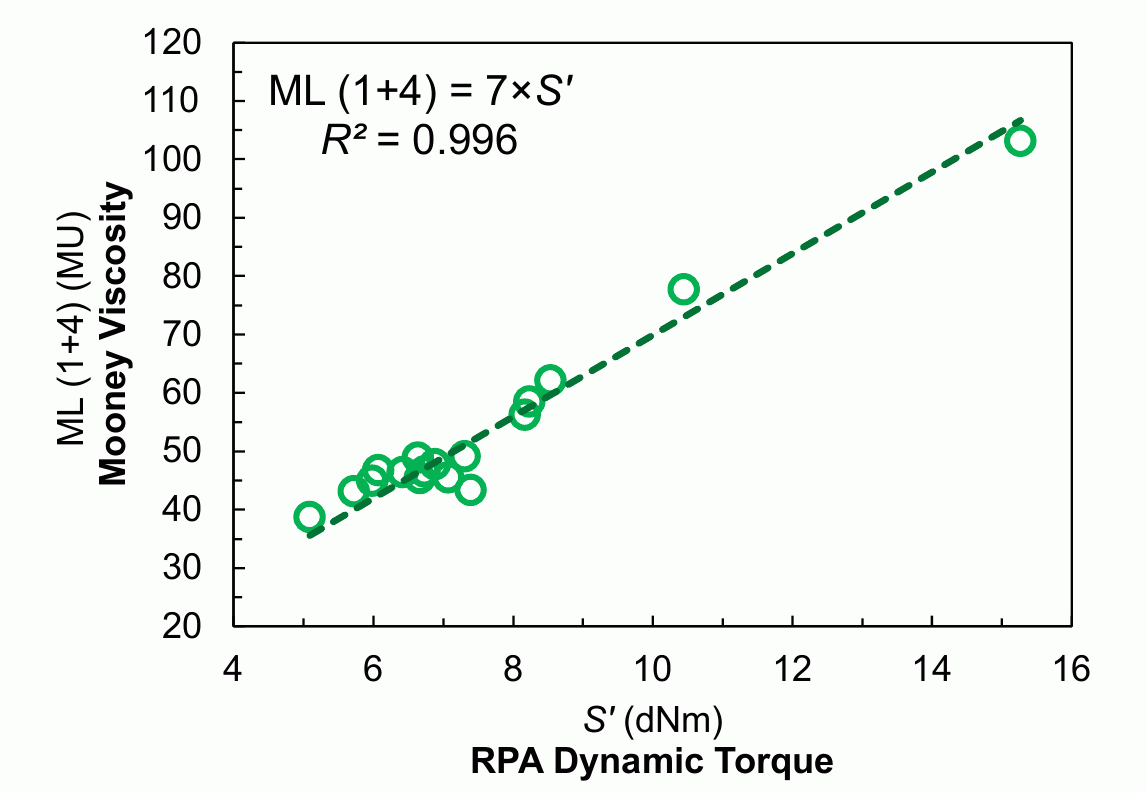
Raw elastomers. ML(1+4) vs. S′ for 17 unfilled elastomers (EPDM, BR, IIR, NBR, SBR). 100 °C, low frequency, high strain. R² = 0.996.
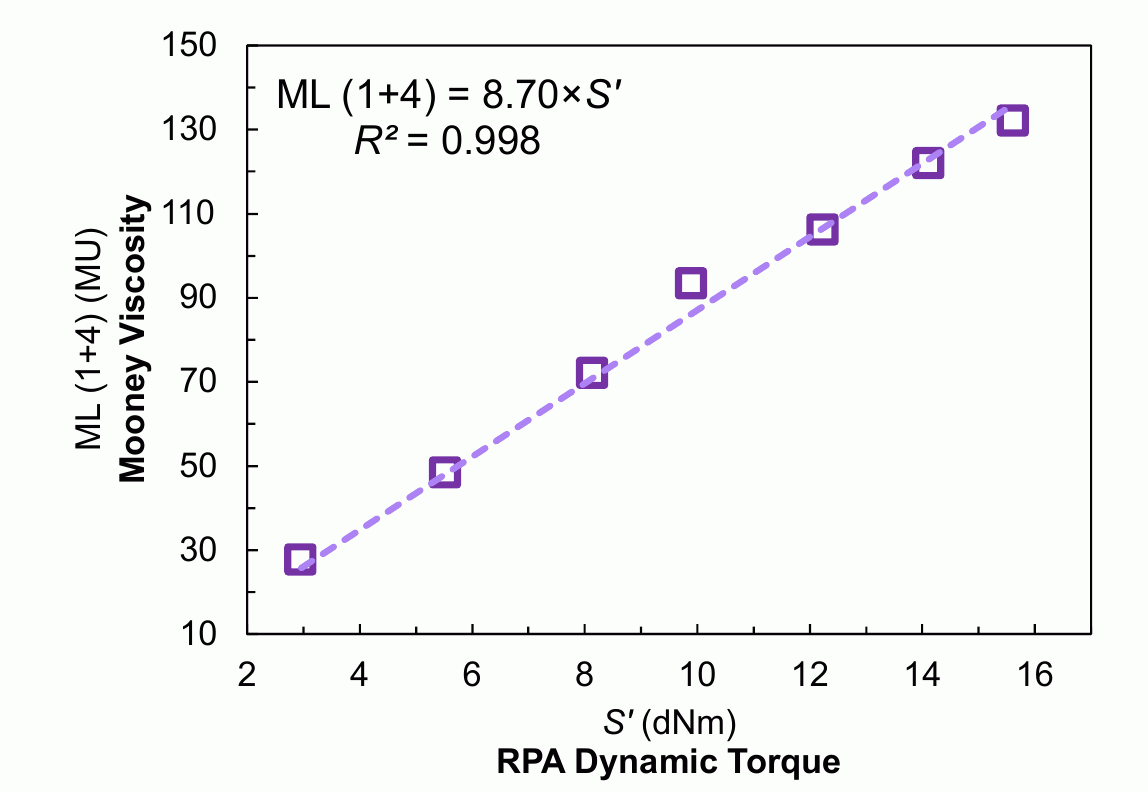
Filled compounds. ML(1+4) vs. S′ for 7 rubber compounds. 100 °C, low frequency, high strain amplitude. R² = 0.998.
Where to keep the Mooney. Correlation runs strongest within one rubber family. Natural rubber and polymers with high long-chain branching remain hard to predict from any RPA condition. The paper explains why.
ABOUT THE PREMIER RPA
Mooney-equivalent results, plus four instruments in one
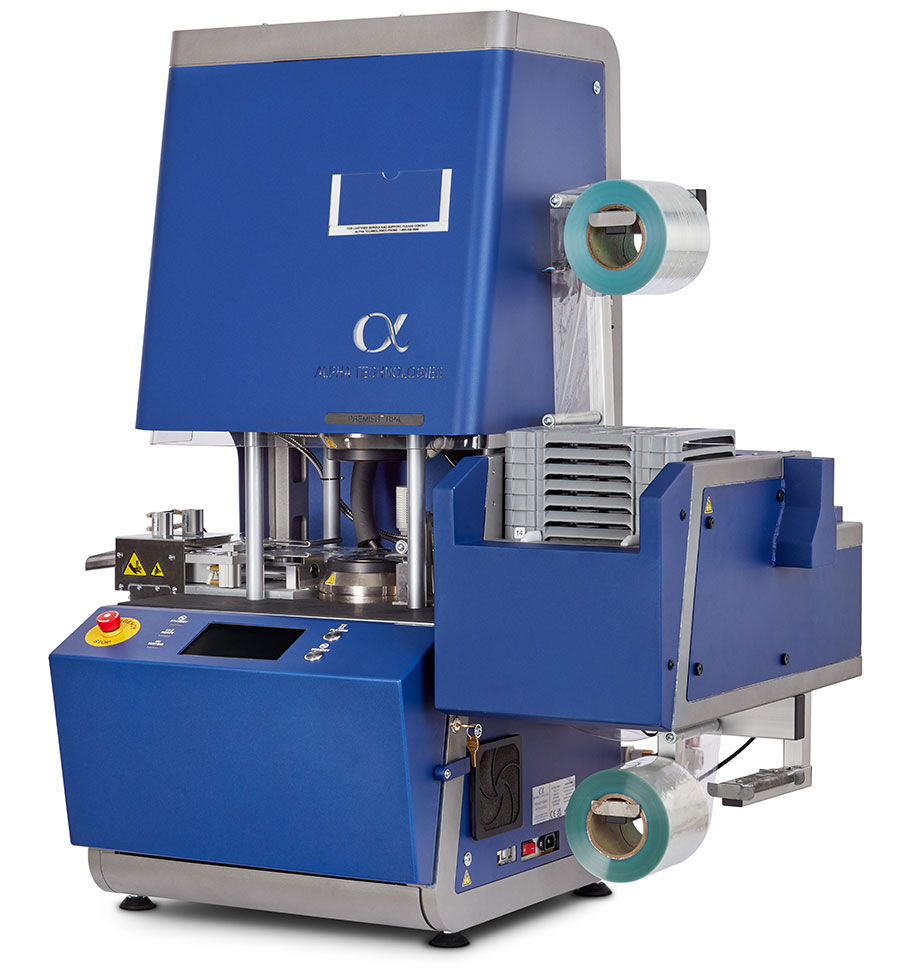
The Premier RPA works as a rheometer for raw elastomers, a processability tester for compounds, a cure meter for materials with curatives and a dynamic mechanical analyzer for vulcanizates. The MV-RPA test adds a Mooney-equivalent result to the same automated platform.
- Mooney-equivalent ML(1+4) from elastic torque S′
- Elastic and viscous components (S′ and S″)
- Molecular weight, MWD and long-chain branching indicators
- Cure, scorch and processability data
MORE RESOURCES
Go Deeper on Mooney to RPA
The short version of the study, straight answers to common questions, and an on-demand webinar on what a single Mooney number leaves out.
Reproducing Mooney Viscosity Using the Rubber Process Analyzer
Application note. The test approach, both correlation charts and what the MV-RPA test adds beyond the Mooney number.
The Hidden Cost of a One-Number Spec: What Your Mooney Test Doesn’t Tell You
On-demand webinar. What the Mooney test measures, the limits of a single-point test and the correlation science behind S′, high strain and 0.1 Hz.
Mooney Viscometer vs. RPA: What to Keep, What to Move
Article. Straight answers on correlation, CoAs, filled compounds, natural rubber and which standard applies.
COMMON QUESTIONS
Mooney to RPA Questions, Answered
Does the RPA give the same number as my Mooney viscometer?
It gives a Mooney-equivalent ML(1+4) value calculated from the elastic torque S′. In Alpha’s study, S′ correlated with ML(1+4) at R² = 0.996 across 17 unfilled elastomers (100 °C, low frequency, high strain) and R² = 0.998 across 7 filled compounds (100 °C, low frequency, high strain amplitude). The two instruments deform the sample in different ways, so treat the result as equivalent, not identical.
What test conditions does the MV-RPA test use?
The customized Alpha MV-RPA test runs at 100 °C, low oscillation frequency and high strain amplitude. The technical paper shows how each setting affects the correlation with Mooney viscosity.
Why does the test use S′ instead of the complex modulus G*?
At low strain, G* correlates well with Mooney viscosity. As strain rises into the nonlinear region, G* correlation drops and S′ correlation rises. High strain better reflects the deformation inside a Mooney cavity and on the plant floor.
Does the correlation hold for natural rubber?
Natural rubber is the hardest case. Its high molecular weight and gel content often keep the Mooney torque from reaching a steady state within the standard 4 minutes. That makes a clean comparison difficult from either instrument. Talk to an application engineer about your NR grades.
Do I need to retire my Mooney viscometer?
No. Many specs and certificates of analysis still call for ML(1+4). A practical first step: run both instruments and build a correlation on your own materials. An Alpha application engineer can help you plan it.
What else does the RPA measure?
The RPA works as four instruments in one: a rheometer for raw elastomers, a processability tester for compounds, a cure meter for materials with curatives and a dynamic mechanical analyzer for vulcanizates. You get elastic and viscous components (S′ and S″), molecular structure indicators such as molecular weight, molecular weight distribution and long-chain branching, and cure data.
TALK TO AN EXPERT
Will MV-RPA work for your materials?
Ask an Alpha application engineer. We’ll review your materials and your Mooney workflow, help you plan your own correlation and plan for your CoA requirements.