
Your lab runs a Mooney test on every lot. Each test means pulling samples from a hot rotor by hand. The result is one number at one low shear rate, and it tells you little about how the material will process.
The Premier RPA reproduces Mooney viscosity ML(1+4) in an automated test called the Alpha MV-RPA test. So which Mooney work moves to the RPA, and which work stays? Here are straight answers to the seven questions lab managers ask most.
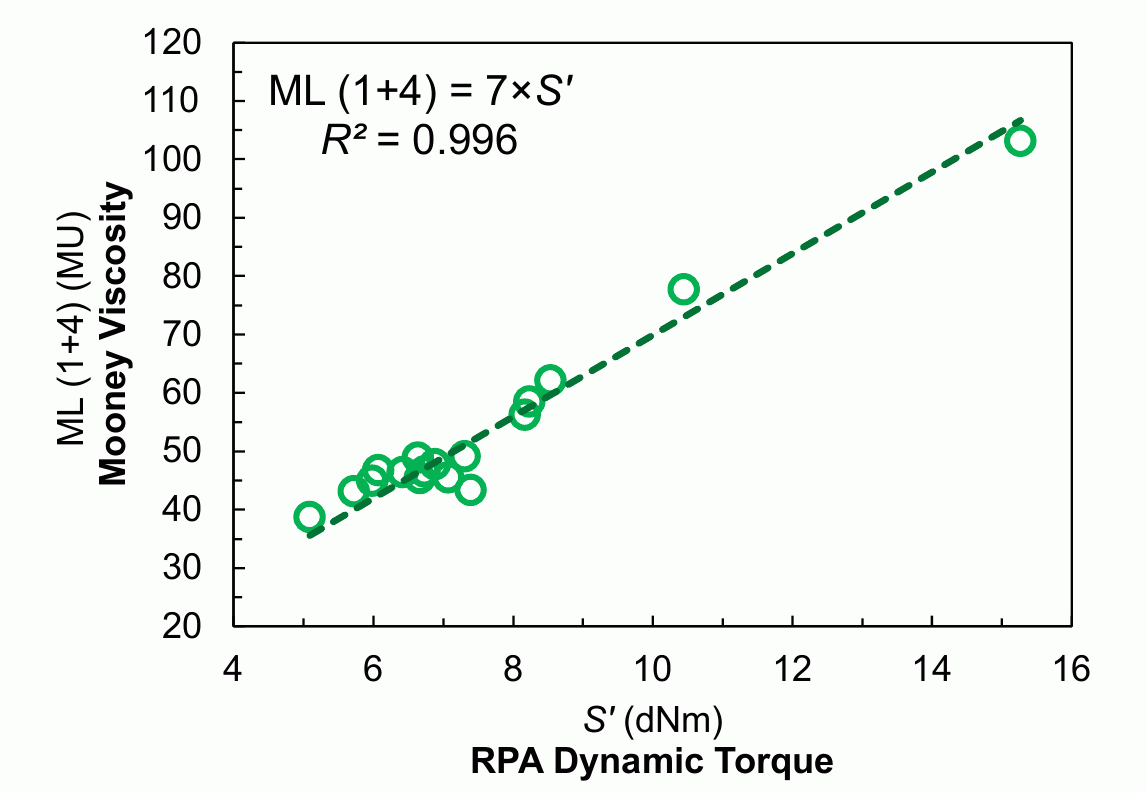
- The Alpha MV-RPA test gives you a Mooney-equivalent ML(1+4). R² = 0.996 across 17 unfilled elastomers (100 °C, low frequency, high strain). R² = 0.998 across 7 filled compounds (high strain amplitude).
- Keep a Mooney for certificate-of-analysis lots where contracts call for one. Move R&D, incoming QC and process-control testing to the RPA.
- Natural rubber needs a material-by-material review. Correlation runs strongest within one rubber family.
1. Does the RPA give me a Mooney number?
Yes. It gives you a Mooney-equivalent value. The Alpha MV-RPA test runs the Premier RPA at 100 °C, low frequency and high strain. Under these conditions, the elastic torque S′ tracks ML(1+4).
Alpha tested 17 unfilled elastomers: EPDM, BR, IIR, NBR and SBR. The fit was ML(1+4) = 7 × S′, with R² = 0.996 (100 °C, low frequency, high strain).
The test conditions matter. A Mooney viscometer measures at low shear, with a maximum shear rate of 1.6 s⁻¹ at 2 rpm at the rotor edge. Raise the RPA frequency and the link to Mooney breaks down. In a set of 11 unfilled BR grades tested at 5 Hz and 7% strain, the correlation between G* and Mooney fell to near zero. Low frequency keeps the RPA result on the Mooney scale.
2. Do I still need a Mooney for CoAs?
For now, many labs keep one. If your customer contracts specify ASTM D1646 Mooney values on the certificate of analysis, keep a Mooney for those lots. Talk with your customers before you change what the CoA reports.
Most Mooney volume sits outside CoA lots. R&D samples, incoming raw-material QC and process-control checks all move to the RPA. Those tests run on the autosampler with no manual hot-rotor handling. Each one returns viscoelastic data along with the Mooney-equivalent value.
Keep on the Mooney
- Contract certificate-of-analysis lots
- Natural rubber grades you have not correlated
Move to the Premier RPA
- R&D samples
- Incoming raw-material QC
- Process-control checks
3. Does it work for filled compounds?
Yes. Alpha tested 7 compounds with reinforcing fillers at high strain amplitude. The fit was ML(1+4) = 8.70 × S′, with R² = 0.998.
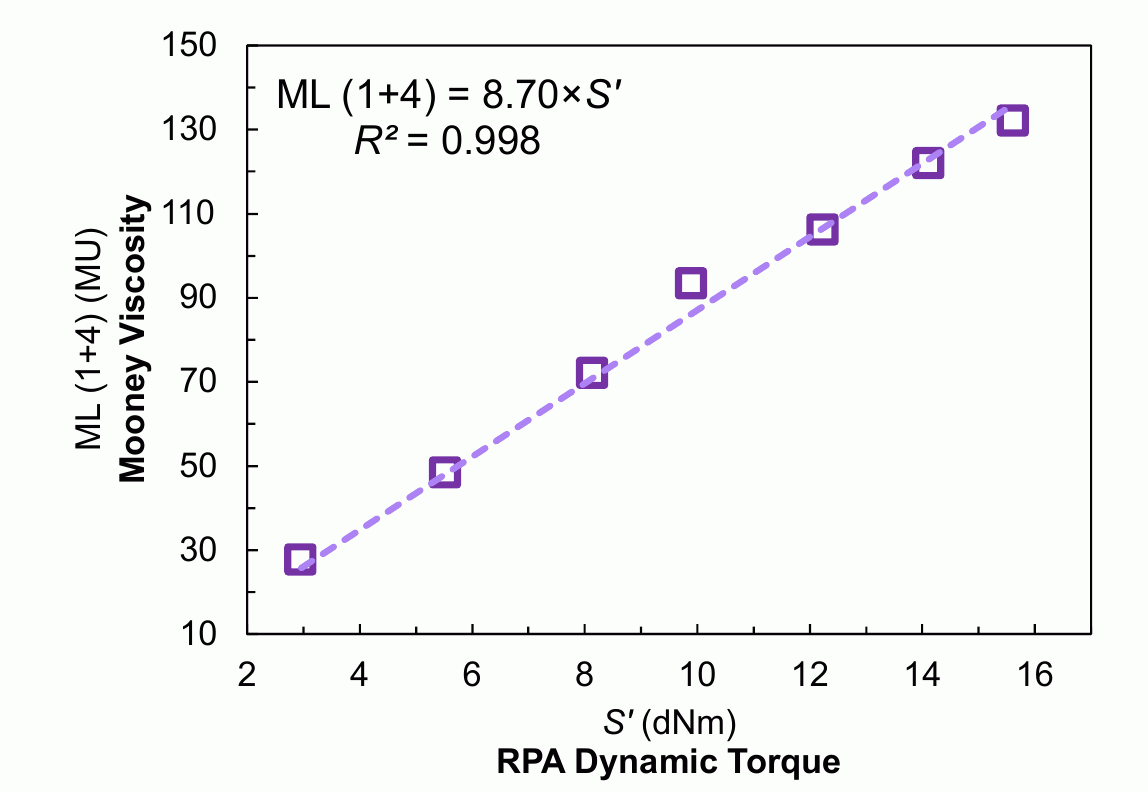
The slope differs from the raw elastomer result (8.70 against 7). Build one correlation for raw elastomers and a separate one for filled compounds. Do not apply the raw-polymer factor to a filled stock.
4. What about natural rubber?
Natural rubber is harder to correlate. In the technical paper, NR Mooney results often did not reach a steady state within the 4-minute test window. Without a stable Mooney reading, the correlation has a weak reference point.
Long-chain-branched polymers show the same pattern and correlate less well. If NR makes up a large share of your Mooney work, review it grade by grade with an Alpha application engineer before you move it.
5. Which standard applies?
Two standards cover this work.
Covers Mooney viscosity. It stays the reference method, and the MV-RPA test reports a value correlated to it.
Covers rheological testing of unvulcanized rubber on rotorless shear rheometers such as the RPA.
So the D1646 vs D6204 question has a simple answer. D1646 defines the Mooney number your customers know. D6204 governs the RPA platform your lab runs it on.
6. How do I build a correlation for my materials?
The published fits come from Alpha’s sample sets. Your materials need their own correlation. Follow these steps:
- Pick one rubber family. Correlation runs strongest within a family.
- Select lots across your full Mooney specification range, low to high.
- Test the same lots on your Mooney viscometer and on the Premier RPA with the MV-RPA test.
- Plot ML(1+4) against S′ and fit a line. Check the R² and the scatter at the ends of your range.
- Run both instruments side by side on production lots before you shift the volume.
Repeat the process for each family and for filled compounds. An Alpha application engineer will help you set up the test and review the data.
7. What else does the RPA measure?
A Mooney viscometer gives you one number. The RPA works as four instruments in one:
Each MV-RPA run reports the elastic and viscous components of the response, along with the Mooney-equivalent value. The same instrument runs cure tests and processability tests on the same platform. Two lots with the same Mooney number process differently when their viscoelastic behavior differs. The RPA shows you this difference.
The bottom line
Keep a Mooney for contract CoA lots and for natural rubber grades you have not correlated. Move routine Mooney volume to the Premier RPA. You get a Mooney-equivalent ML(1+4) from an automated test, with no hot rotor to handle and more data per test.
Keep the Mooney Number. Gain the Viscoelastic Data.
Get the full study: the strain and frequency findings, the raw and filled compound data and the limits of the method.
Test the method on your own materials
Want to test the MV-RPA method against your own materials and CoA requirements? An Alpha application engineer can help you plan your correlation.