

Introduction
Errors in the conception of composite materials can lead to disappointing mechanical properties. DMA is a powerful tool for determining the properties of a wide variety of materials. Among other techniques, DMA is considered one of the most reliable methods for measuring the glass transition temperature (Tg).
The glass transition temperature corresponds to the transition of a material from a hard and relatively brittle “glassy” state to a viscous or rubbery state. This transition is highly dependent on the chemical structure and composition of the material, and even small variations can lead to significant differences in Tg values.
Since different manufacturing or operating conditions can result in variations in the chemical structure of a material, the glass transition temperature can be used to identify manufacturing defects. In other words, DMA can serve as a reliable instrument for chemical process control, such as curing. This application note illustrates how an inadequate curing process can be identified using DMA measurements.
FREE DOWNLOAD
Introduction to Dynamic Mechanical Analysis for Rubber Materials
Materials & Methods
Specimens
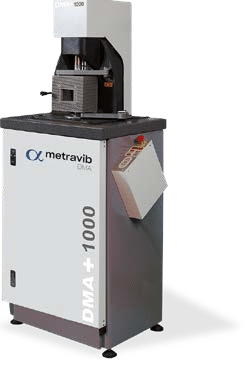
Epoxy materials were studied using the Alpha Metravib DMA+1000 in tension mode. A rectangular epoxy specimen with dimensions of 5 × 5 × 1 mm³ was prepared.
Methods
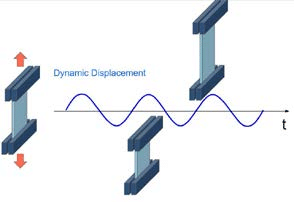
A sinusoidal dynamic displacement was applied to the specimen during a temperature sweep from 25°C to 250°C (see Figure 2 and Table 1) at a heating rate of 2°C/min. A small dynamic strain was applied in order to remain within the linear viscoelastic domain of the material, which is recommended for tests aimed at determining the glass transition temperature.
A static strain was also applied to prevent buckling and to keep the specimen slightly stretched. The test was then repeated on the same specimen to observe changes induced by curing inside the DMA thermal chamber during the first run.
| Dynamic | 0.1% |
|---|---|
| Frequency | 1 Hz |
| Static | 0.2% |
| Temperature | 25°C to 250°C, 2°C/min |
Results
Figure 3 shows the storage modulus E′ and tan δ as a function of temperature at 1 Hz, from 25°C to 250°C. The results from two successive measurements performed on the same specimen are shown.
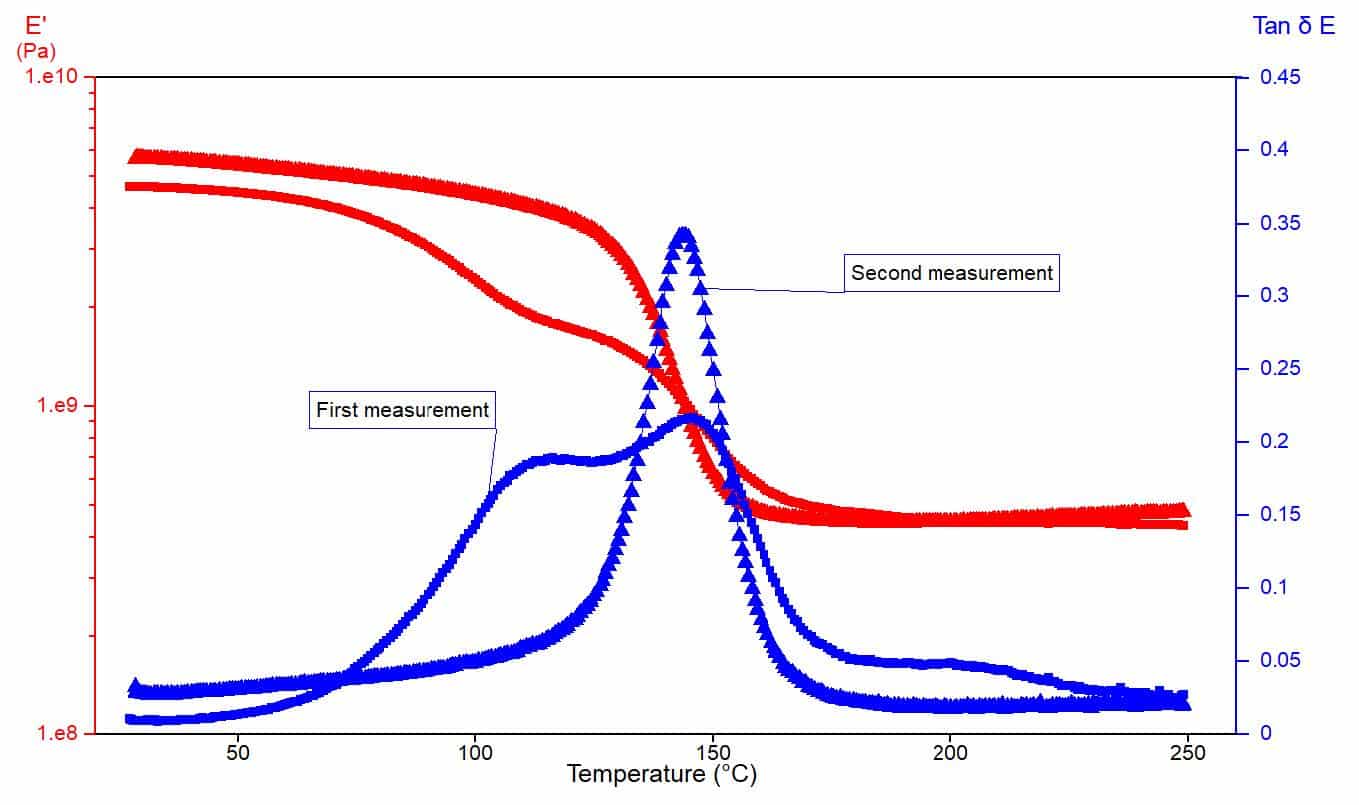
During the first measurement, a decrease in modulus is observed in two steps: the first above 100°C and the second slightly below 150°C. Two tan δ peaks are observed at approximately 100°C and 150°C. These results, characterized by two distinct glass transitions, are typical of a material composed of two polymer phases, with each change in E′ or tan δ attributed to one component of the material.
The second measurement exhibits a markedly different behavior: the decrease in E′ and the tan δ peak observed at 100°C are no longer present, while the transition around 150°C remains. In other words, the first measurement reveals two tan δ peaks for the epoxy matrix, which is no longer the case during the second measurement.
This behavior indicates that the temperature inside the DMA thermal chamber was sufficient to complete the curing of the specimen. The differences observed between the two runs are therefore attributed to the curing process and the resulting changes in chemical structure. The glass transition observed at 100°C during the first run is associated with the uncured portion of the material, which becomes fully cured during the first temperature sweep. As a result, this transition is no longer observed during the second measurement.
Additionally, the tan δ peak observed during the second measurement is higher than during the first, indicating a distinct viscoelastic behavior after curing.
FREE DOWNLOAD
Introduction to Dynamic Mechanical Analysis for Rubber Materials
Conclusions
DMA is a key technique for determining the viscoelastic properties of polymer materials and can therefore be effectively used as a quality control tool. In this example, DMA measurements reveal that the epoxy composite was initially insufficiently cured, as evidenced by the presence of two tan δ peaks instead of a single, expected transition. The first temperature sweep completed the curing process, explaining the disappearance of the lower-temperature tan δ peak during the second measurement. To download the full PDF, click here.
KEY TAKEAWAY
DMA temperature sweeps can identify incomplete curing by revealing changes in glass transition behavior, making DMA an effective tool for curing quality control.
LEARN MORE ABOUT DMA
Introduction to Dynamic Mechanical Analysis for Rubber Materials
How rubber engineers evaluate real world material behavior
Inside the guide: guidance for improving analysis quality and useful direction for integrating DMA into research, development, and testing workflows.