

Introduction
During polymer manufacturing, molecules often do not have sufficient time to move into the positions or conformations that correspond to the processing temperature. As a result, polymer chains can become frozen in configurations far from their optimal state. This leads to excess free volume between polymer molecules, which gradually decreases over time as the molecules move closer together. As the polymer structure becomes more compact, its mechanical properties change. This time-dependent evolution of material properties is referred to as physical aging.
Physical aging can have a significant impact on the durability and performance of polymers in their respective applications. Therefore, it is essential to understand and characterize physical aging behavior.
This study was performed to demonstrate the effect of physical aging on the mechanical properties of polymers and to highlight the capability of DMA to characterize physical aging phenomena.
FREE DOWNLOAD
Introduction to Dynamic Mechanical Analysis for Rubber Materials
Materials & Methods
The material tested in this study was PVC (polyvinyl chloride). PVC is the world’s third most widely produced synthetic polymer and is commonly used in industries such as construction, phonograph records, and canvas production.
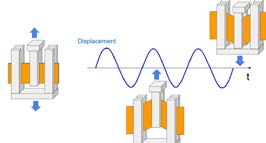
The specimens were tested in shear mode (see Figure 2). Each specimen had dimensions of 1.5mm thickness, 1.5mm width, and 11.3mm length. A dynamic strain of 2.5% was applied to the specimen without any static strain.
Since the objective was to evaluate the effect of aging on polymers, five PVC specimens with different aging times (12, 24, 50, 100, and 200 hours) were tested. The measurement parameters are summarized in Table 1.
Table 1. Test Parameters
| Dynamic | 2.5% |
|---|---|
| Frequency | 5 Hz |
| Temperature | −50°C to 150°C (2°C/min) |
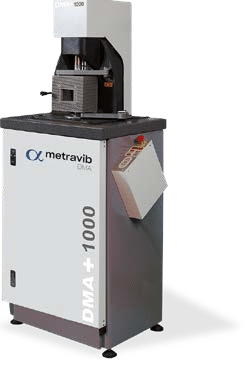
| DMA | DMA+1000 |
| Test mode | Shear Film |
FREE DOWNLOAD
Introduction to Dynamic Mechanical Analysis for Rubber Materials
Results
Figure 3 shows the results obtained from temperature sweeps performed on five specimens aged for 12, 24, 50, 100, and 200 hours. The results are presented in terms of shear storage modulus (G′) and tan δ.
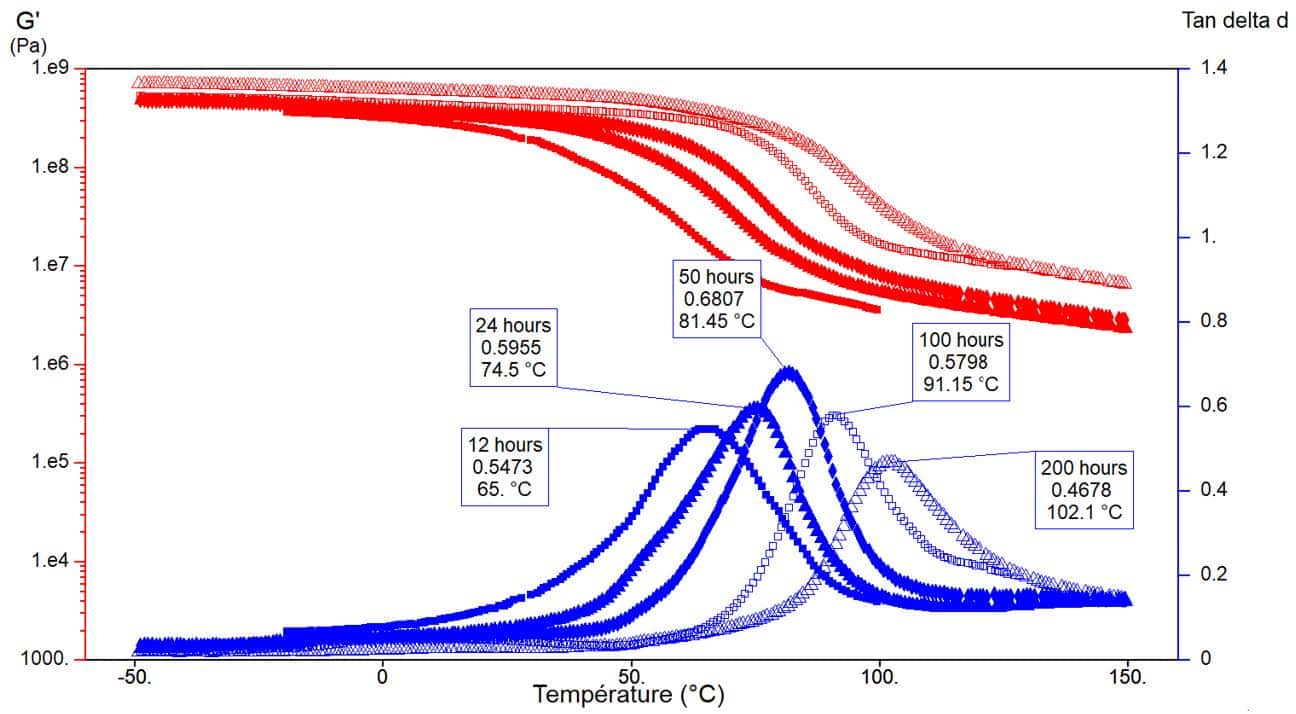
It can be observed that the stiffness of the material increases with aging time. This behavior is attributed to the increasing density of the polymer structure, which reduces molecular mobility and leads to increased material stiffness.
Physical aging also affects the glass transition temperature (Tg) of the material. The Tg values of the five specimens aged for 12, 24, 50, 100, and 200 hours were found to be approximately 65°C, 75°C, 82°C, 91°C, and 102°C, respectively.
During industrial processing, polymers typically undergo rapid cooling from high temperatures and are therefore left in a thermodynamically non-equilibrium state. As a consequence, the molecular conformation of macromolecules evolves slowly through spontaneous relaxation toward equilibrium [1]. As a result of this relaxation process, aged polymers exhibit a glass transition temperature that is higher than that of unaged polymers.
Conclusions
This study highlights the importance of analyzing aged polymers, as such analysis can be valuable for estimating the service life of polymer materials.
Temperature sweeps performed from −50°C to 150°C on PVC specimens aged for 12, 24, 50, 100, and 200 hours showed a clear increase in both shear storage modulus (G′) and glass transition temperature with increasing aging time. To download the full PDF, click here.
KEY TAKEAWAY
DMA temperature sweeps reveal aging-induced increases in stiffness and glass transition temperature, enabling characterization of physical aging in polymers.
References
- Rikardo Minguez et al. A simple approach to understand the physical aging in polymers. European Journal of Physics, 2018, 40, 015502.
LEARN MORE ABOUT DMA
Introduction to Dynamic Mechanical Analysis for Rubber Materials
How rubber engineers evaluate real world material behavior
Inside the guide: guidance for improving analysis quality and useful direction for integrating DMA into research, development, and testing workflows.